
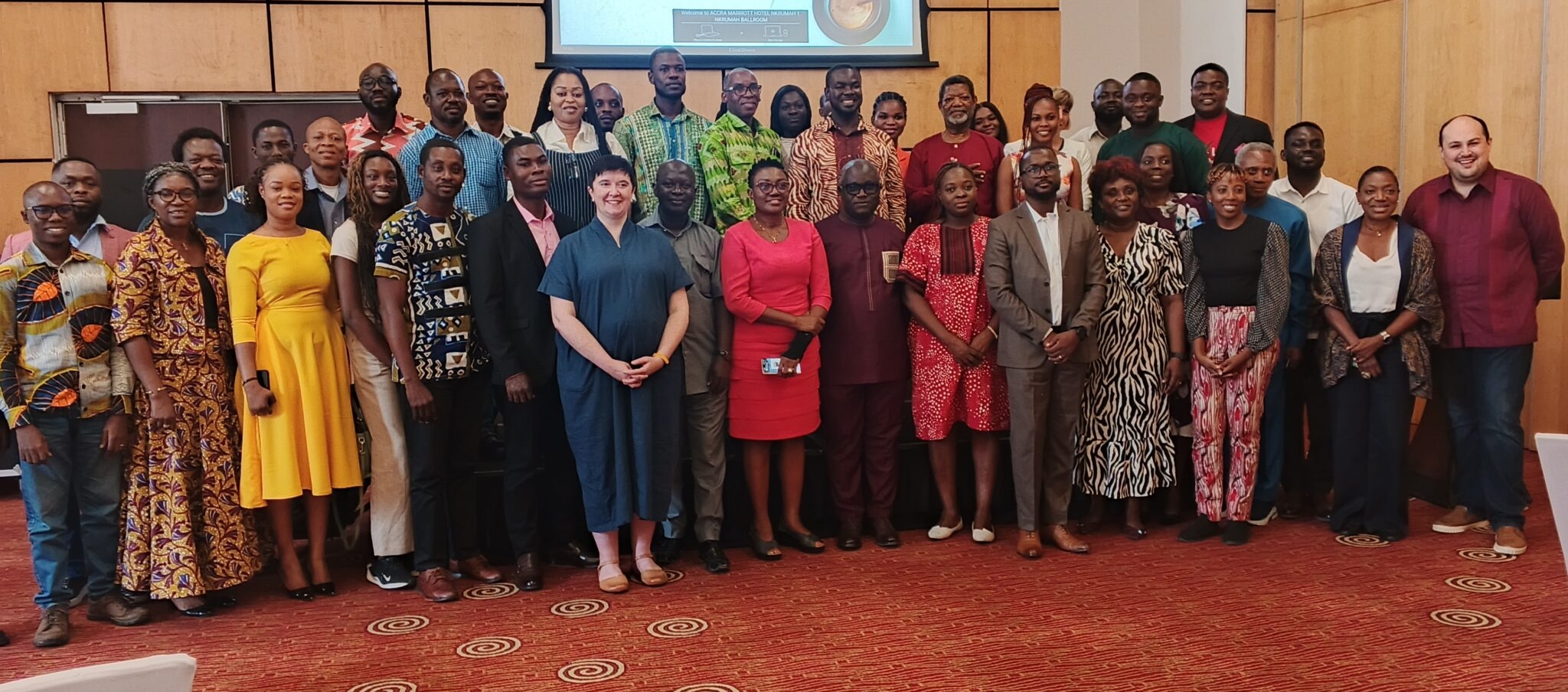
Researchers, policymakers, cocoa industry leaders, development practitioners, and academics gathered in Accra on 22 June 2026 for a high-level Research and Policy Breakfast to discuss emerging evidence on the impacts of climate change on Ghana's cocoa sector and the urgent need for a more producer-centred approach to climate policy.
The event, hosted under the research project "Towards a Cocoa Producer-Focused Climate Policy in Côte d'Ivoire and Ghana," brought together representatives from government institutions, COCOBOD, the private cocoa sector, civil society organisations, development partners, universities, and farmer-focused organizations to deliberate on the future of cocoa production in the face of increasing climate risks.
The research, led by the Institute for Rural Development and Innovation Studies (IRDIS) at Kwame Nkrumah University of Science and Technology (KNUST) for the Ghana component, in collaboration with the Institute of Cacao and Chocolate and international partners, is supported by the Harvard University Center for African Studies through the Motsepe Presidential Research Accelerator Fund for Africa.
Presenting the findings, Dr. Albert Arhin of IRDIS highlighted that climate change is no longer a distant threat but a present reality affecting cocoa farmers across Ghana's cocoa-growing regions. Drawing on evidence from ten cocoa-growing communities in the Ashanti, Eastern, and Western Regions, the study found widespread experiences of rising temperatures, prolonged droughts, erratic rainfall patterns, declining yields, increasing production costs, and growing livelihood insecurity among cocoa farmers.
A key message emerging from the study was that climate change is affecting not only cocoa production but also the health, wellbeing, labour productivity, and adaptive capacity of cocoa producers themselves. Farmers reported increasing physical exhaustion, reduced working hours due to extreme heat, stress and anxiety about the future of cocoa farming, and growing challenges in sustaining their livelihoods.
The research argues that while existing climate and sustainability interventions have largely focused on improving yields, managing pests and diseases, and promoting environmental compliance, insufficient attention has been paid to the people whose labour sustains cocoa production. The study therefore calls for a transition from a traditional yield-centred approach towards a producer-centred resilience model that places farmer health, wellbeing, productivity, and adaptive capacity at the centre of climate adaptation efforts.
Participants at the breakfast meeting engaged in lively discussions around the implications of the findings for Ghana's cocoa sector. Issues raised included the effectiveness of existing adaptation interventions, the role of climate finance, farmer participation in cocoa governance, labour shortages, youth engagement in cocoa farming, and the need to strengthen institutional support systems for cocoa-producing communities.
The policy brief presented at the event outlined an Eight-Point Agenda for a Cocoa Producer-Focused Climate Policy. Key recommendations included strengthening climate adaptation investments, improving water management systems, integrating adaptation support with living income initiatives, expanding adaptation financing, promoting farmer well-being, strengthening farmer participation in decision-making, and repositioning cocoa resilience as a national economic priority.
Participants welcomed the research as a timely contribution to ongoing national and international debates on climate resilience, cocoa sustainability, and rural livelihoods. Many noted that the findings challenge conventional approaches to cocoa policy by demonstrating that sustaining cocoa production ultimately requires sustaining cocoa producers.
The breakfast meeting forms part of a broader research initiative being undertaken in Ghana and Côte d'Ivoire to generate evidence that can inform climate policy, cocoa sector reforms, and sustainability investments across West Africa.
The research team includes Dr. Carla Martin (Harvard University), Dr. Albert Arhin (KNUST), Jose Lopez Ganem (Institute for Cocoa and Chocolate Research), Dr. Amanda Berlan (University of Leicester), Richard Tetteh (KNUST), Michael Ehis Odijie (University of Oxford), and Jean-Luc Kouassi (Côte d'Ivoire).
As climate change continues to reshape agricultural systems across the region, the study underscores a simple but powerful message: a climate-resilient cocoa sector requires climate-resilient cocoa producers.